

Menu
✕
April 29, 2026>Board360

SHORT ANSWER: Yes, for most CAs targeting internal audit. Indian CAs earn the CIA via a single 150-question Challenge Exam, not three parts. It adds global recognition, a 30 to 40 percent salary premium in audit roles, and direct access to the CAE track at MNCs and GCCs.
The CA is one of the most respected finance qualifications in India. But in internal audit specifically, it is a generalist credential. It covers external audit, taxation, and financial reporting. It does not signal, to global employers, that you have specialized in internal audit governance, risk-based methodology, and IIA standards.
The CIA does exactly that. It is the only globally recognized certification specifically for internal audit professionals. For a qualified CA in India, adding the CIA is faster, cheaper, and more strategically targeted than most candidates realize.
This post covers the Challenge Exam fast-track available to Indian CAs, what the CIA adds to your career, what the salary difference looks like, and how to decide whether it is the right move for you.
Your CA training built expertise in Indian financial reporting, taxation, statutory audit, and accounting standards. These are applied in external audit, tax practice, and advisory. They are India-centric by design.
The CIA is built around the Global Internal Audit Standards (GIAS), which replaced the previous IPPF framework in 2025. GIAS defines how internal audit functions should be structured, how risk-based audit planning works, how the audit committee relationship is managed, and how quality assurance programs are maintained. These are universally applicable across jurisdictions.
A CA holding the CIA tells an employer two things. First, you have the financial and accounting foundation that the CA guarantees. Second, you have internalized a globally recognized framework for internal audit that non-CIA candidates cannot claim. In India's growing internal audit market driven by MNCs, GCCs, and large corporates under pressure to align with global governance standards, this combination is a genuine career accelerator.
This is the most important practical detail in this post. Indian CAs do not need to sit three separate CIA exams.
The IIA's CIA Challenge Exam (Accounting path) is open to active members of recognized accounting bodies. ICAI is explicitly listed as an approved body. Qualified and active ICAI members take a single 150-question exam instead of all three standard CIA parts.
The Challenge Exam covers approximately 80 percent of the standard syllabus. For a CA, the overlap with your existing knowledge is significant. Articleship experience, financial reporting knowledge, and audit methodology foundation already cover a large portion of the exam. The genuinely new material for CAs is the GIAS framework, internal audit engagement management, quality assurance programs, and governance reporting structures.
Typical preparation time for a CA is 8 to 12 weeks. This compares to 12 to 18 months for a non-CA candidate completing all three standard CIA parts.
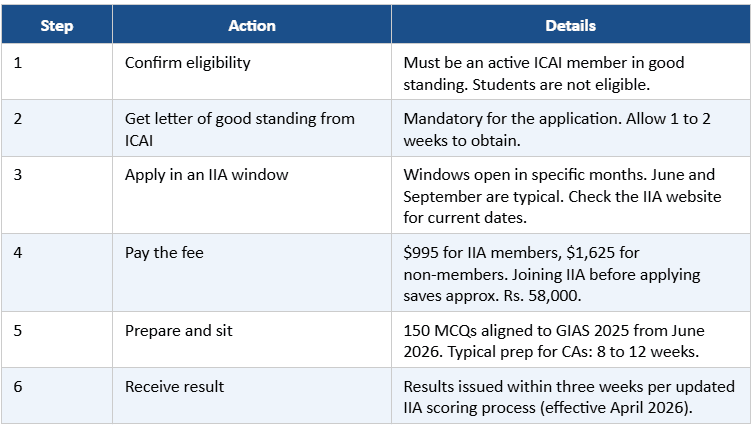
Important for 2026: The Challenge Exam syllabus is being updated to align with GIAS 2025, effective June 2026. If you are preparing for an exam in or after June 2026, confirm your study materials reflect the updated syllabus. Pre-2025 materials based on the old IPPF framework should not be used. Board360.ai's CIA program is powered by HOCK International, which maintains current GIAS alignment.
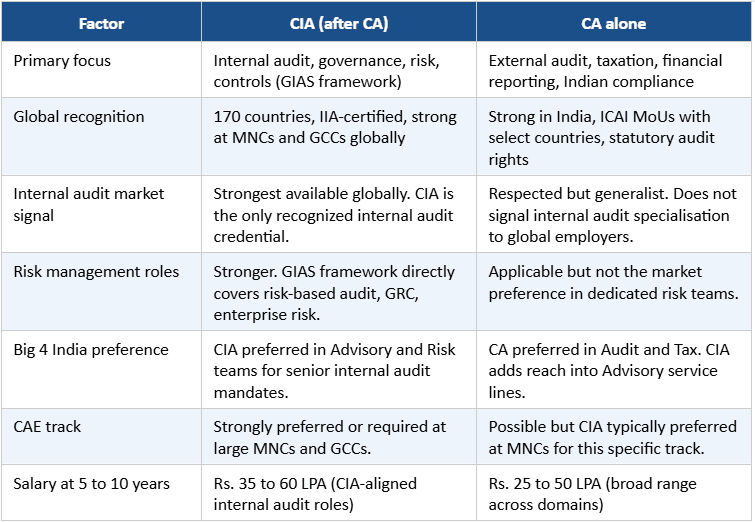
The conclusion is not that CIA replaces CA. A CA without CIA is a strong generalist. A CA with CIA is a credentialed internal audit specialist. In internal audit, risk management, GRC, and governance advisory, the CIA closes a gap the CA does not fill.
All four Big 4 firms have internal audit and risk advisory practices. These handle internal audit outsourcing mandates, SOX and ICFR advisory for MNCs, regulatory compliance reviews, and enterprise risk management engagements for large clients.
In Advisory and Risk service lines across Deloitte, EY, PwC, and KPMG, the CIA is actively valued at the Senior Associate level and above. At Manager level and above, it is increasingly listed as preferred or required for roles involving client delivery on IIA-standards-aligned engagements.
Beyond Big 4, the highest demand for CA-plus-CIA professionals comes from BFSI GCCs. JP Morgan, Goldman Sachs, Citibank, and HSBC run structured internal audit functions out of their India GCC operations. These roles explicitly list CIA as preferred, and professionals with CA-plus-CIA credentials see higher starting packages than CA-only candidates in the same hiring cohort.
According to IIA global salary data, CIA-certified professionals earn 37 to 51 percent more than non-certified internal auditors globally. In India, the premium for CIA holders over non-CIA peers in internal audit roles is consistently reported at 30 to 40 percent.
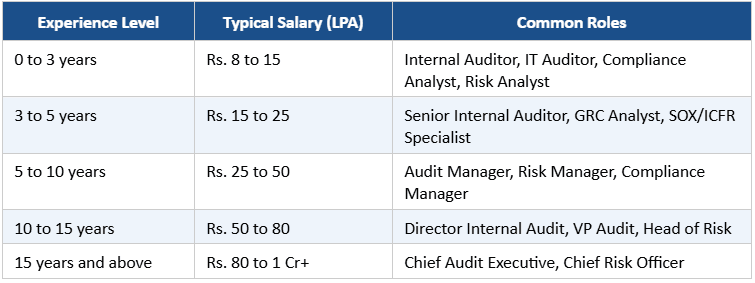
The most significant single salary jump for CIA holders typically comes at the 5 to 8 year mark when moving from Senior Internal Auditor to Audit Manager. This transition can add Rs. 10 to 20 LPA in one move, particularly at BFSI GCCs and large MNC in-house audit functions. The CIA is often the enabling factor that opens access to these manager-level roles at global employers.
The CIA makes strong sense if any of these apply.
The CIA is less directly useful if your career focus is primarily statutory audit, domestic taxation, or Indian regulatory compliance. The CA carries full authority in those domains and the CIA adds limited incremental value there. The decision is about where you want your career to go.
Do CA students get exemptions in the CIA exam in India?
Qualified and active ICAI members are eligible for the CIA Challenge Exam (Accounting path), which replaces all three standard CIA parts with a single 150-question exam. This is not an exemption from the exam but a fast-track route. Students who have not yet qualified as CAs do not hold active ICAI membership and are therefore not eligible. The Challenge Exam requires a current letter of good standing from ICAI confirming active membership.
What is the CIA salary uplift after CA in India?
CIA holders in internal audit roles in India earn 30 to 40 percent more than non-certified peers at equivalent experience levels. At the 3 to 5 year mark, CIA-aligned roles typically pay Rs. 15 to 25 LPA compared to Rs. 12 to 18 LPA for CA-only internal audit professionals. The gap widens further at senior levels where CIA is often a prerequisite for manager-level and above roles at global employers.
Which Big 4 prefers CIA over CA in India?
All four Big 4 firms value both credentials in different contexts. In internal audit and risk advisory service lines, CIA is explicitly preferred or required at the Senior Associate level and above. EY and KPMG in particular are known for structured internal audit outsourcing practices where CIA is a key hiring criterion. In statutory audit and tax service lines, the CA remains the primary credential. The combination of CA and CIA gives access to both domains across all four firms.
Is CIA better than CA for risk management roles in India?
For dedicated risk management and GRC roles at MNCs, Big 4 Advisory, and BFSI GCCs, the CIA is more directly targeted. The GIAS framework explicitly covers risk-based audit, enterprise risk management, and control assurance. The CA covers risk within the broader context of financial reporting and statutory compliance but does not provide the same depth in internal audit methodology and governance frameworks.
How difficult is the CIA Challenge Exam for CA-qualified professionals?
The Challenge Exam is significantly more accessible for qualified CAs than for candidates without an accounting background. The 150-question paper overlaps substantially with CA training in audit methodology, control testing, and compliance. The genuinely new content for CAs is the GIAS framework and IIA-specific governance standards. Most CAs who study specifically for the Challenge Exam are exam-ready in 8 to 12 weeks with updated GIAS-aligned materials.
Is CIA after CA a good path for internal audit jobs in India?
Yes, strongly. The CA-plus-CIA combination is the most powerful credential pairing for internal audit careers in India's corporate sector. The CA provides the financial and accounting foundation. The CIA adds the governance and audit methodology credential that MNC, GCC, and Big 4 advisory employers look for. Internal audit manager and director roles at large employers increasingly list CIA as preferred or required, and the combination significantly accelerates access to these roles compared to CA alone.
Board360.ai's CIA program is powered by HOCK International, IIA-certified and fully aligned with the GIAS 2025 framework. The program covers the standard three-part CIA path and the Challenge Exam fast-track for qualified Indian CAs. The pass rate is 95 percent. A free demo is available. Explore the CIA program at Board360.ai and see how the CA-plus-CIA combination can change your audit career trajectory.