

Menu
✕
June 2, 2026>Board360

If you are considering the Enrolled Agent credential and the first question on your mind is 'what will I actually earn?', this post is for you. The IRS Enrolled Agent salary in India varies significantly based on your employer, city, experience level, and whether you work for a firm or directly for US clients. This breakdown covers every major scenario, from fresher roles right out of the exam to senior positions at Big 4 GCCs and independent freelance practice, with real ranges rather than aspirational numbers.
The demand for US tax professionals in India is structural, not cyclical. According to Reuters reporting on US accounting firm hiring patterns, the US accounting sector had around 1.78 million employees in 2024, about 10% fewer than in 2019. The pipeline of new CPA graduates has not kept pace with retirements, and US firms are actively offshoring work to India to fill the gap.
The Big 4 alone, Deloitte, EY, PwC, and KPMG, had a combined headcount of 140,000 to 160,000 people in their India GCCs as of 2024, with a significant share of that in US tax roles. Mid-sized US firms like RSM are also scaling up fast, with RSM targeting over 5,000 India employees by 2027.
For EAs specifically, this translates to more job openings, faster promotions, and higher starting packages than the market offered three to four years ago. The EA credential is the most direct signal to a US tax team that you understand the IRS's framework, making you a candidate rather than a trainee from day one.
The ranges below reflect verified market data from job listings, industry sources, and professional community inputs as of early 2026. These are India-based salaried roles, not remote billing rates for US clients.
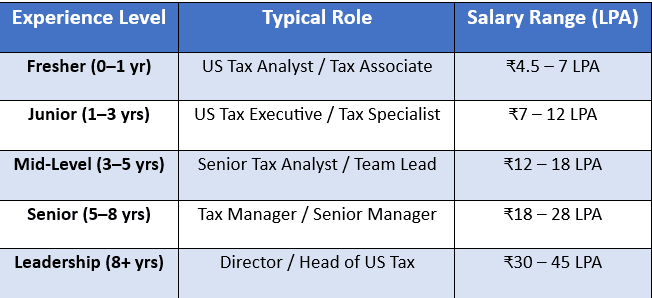
Fresher salaries have risen noticeably since 2022. A B.Com or M.Com graduate who clears all three EA parts and joins a Big 4 GCC or a specialized US tax outsourcing firm can now realistically expect Rs. 5-7 LPA as a starting package, compared to Rs. 4-5 LPA just a few years ago.
Where you work matters as much as your credentials. The same candidate with three years of EA-level experience will be paid differently across employer categories.
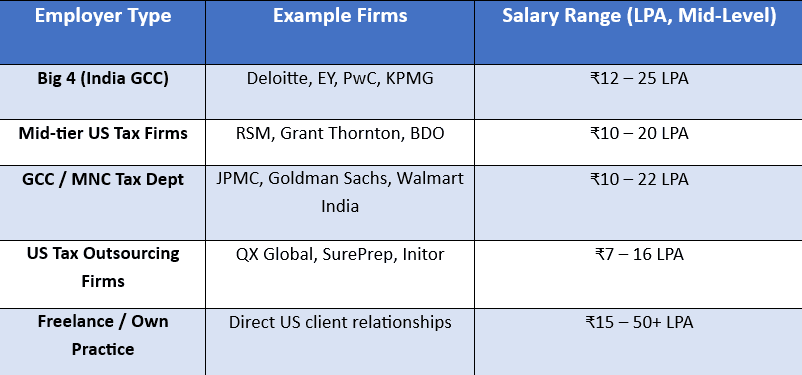
Big 4 firms offer structured career tracks and strong brand value, but pay on the lower end relative to what independent or GCC-based roles can offer at mid and senior levels. The freelance route has the highest ceiling but requires you to build your own client base, which typically takes 2-3 years of salaried experience first.
Deloitte, EY, PwC, and KPMG all run large US tax practices out of their India GCCs, primarily in Hyderabad, Bangalore, Mumbai, and Gurgaon. The work typically spans US individual returns (Form 1040), corporate returns, transfer pricing, and international tax compliance.
At the associate level in a Big 4 US tax team, fresh EA credential holders generally start between Rs. 5 and 8 LPA depending on prior experience and educational background. A B.Com fresher who has passed the EA exam will typically land at the lower end; someone who has 1-2 years of tax experience before clearing the exam will command closer to Rs. 7-9 LPA.
At the senior associate and assistant manager level, typically 3-5 years in, Big 4 US tax professionals with the EA designation earn Rs. 12-18 LPA. At manager level, the range shifts to Rs. 18-26 LPA. Senior managers and directors in specialized international tax roles, particularly those handling transfer pricing or multi-state US tax, can cross Rs. 30 LPA at the larger firms.
KPMG in India specifically has been noted to value the EA credential combination with international taxation expertise, often creating dedicated US tax practice groups where the EA designation is a preferred qualification.
GCCs operated by US multinationals are a growing source of EA employment in India. Companies like JPMorgan Chase, Goldman Sachs, and Walmart India run tax compliance teams out of their GCC offices in Bangalore and Hyderabad. The NASSCOM-Zinnov India GCC Landscape Report 2024 confirmed that India hosts over 1,700 GCCs employing more than 1.9 million professionals, with finance and tax functions forming a significant and growing portion of that headcount.
In-house GCC tax roles differ from Big 4 positions in one important way: you are working for a single parent company's US tax obligations rather than a portfolio of clients. This means deeper specialization but narrower exposure. Compensation at these in-house GCC tax roles tends to be Rs. 10-22 LPA at mid-level, with total compensation (including bonuses and benefits) often making up for any base pay differences versus Big 4.
The advantage of GCC roles for EAs is stability and work-life balance. Big 4 tax seasons can be grueling; in-house GCC roles generally run on a more predictable calendar.
The most common anxiety for new EA candidates is whether the credential pays off quickly enough. The short answer: yes, more so than most comparable finance certifications at the entry level.
A B.Com graduate with no prior work experience who clears the EA exam and joins a mid-tier US tax outsourcing firm or a Big 4 associate program typically starts at Rs. 4.5-6 LPA. This is meaningfully higher than the Rs. 3-4 LPA a typical B.Com fresher without a specialized credential would earn in a general accounts role.
The EA's advantage at the fresher level is not dramatic. It is at the 2-5 year mark that the credential creates a genuine salary separation. A US Tax Analyst with the EA designation and three years of experience typically earns 25-40% more than a peer doing equivalent work without the credential, because the EA formalizes IRS representation rights that employers actively value.
If you are evaluating whether to take the EA exam now or wait, the opportunity cost of waiting is real. The earlier you earn the credential, the earlier the salary premium compounds. If you are still preparing for the exam, you can explore Board360.ai's Enrolled Agent program to understand what the preparation path looks like before you commit.
Freelancing as an EA in India, working directly for US clients or US CPA firms on a contract basis, is the highest-income path available. Experienced EAs with strong US individual tax preparation skills charge anywhere from USD 15 to USD 50 per return, depending on complexity. An EA handling 300-400 US returns per season can generate Rs. 15-35 LPA equivalent, with the high end accessible to specialists in complex areas like stock options, FBAR filings, or expatriate returns.
The freelance route has compounded in opportunity since 2020 because US firms actively look for India-based EAs to handle overflow work during peak tax seasons (January through April). Platforms like Upwork host active listings for US tax preparation contractors, and many Indian EAs build direct relationships with small-to-mid-sized US CPA firms through professional networks.
That said, freelance income is seasonal, variable, and takes time to build. Most EAs who successfully transition to freelance start with 2-3 years of salaried work to build both skills and a client network first. Going freelance directly from the exam without any US tax experience is possible but significantly harder.
Board360.ai's Enrolled Agent program is powered by HOCK International, with a 95% pass rate and full coverage of all three SEE parts. Whether you are a B.Com fresher exploring your first global certification or a CA looking to add an IRS credential to your practice, the program is structured to get you exam-ready efficiently. A free demo is available. Explore the EA program at Board360.ai and take the first step toward the salary ranges covered in this post.