

Menu
✕
April 23, 2026>Board360

QUICK ANSWER: Indian residents apply for a PTIN by mailing Form W-12 and Form 8946 to the IRS. There is no online option without a US Social Security Number. Processing takes 4 to 6 weeks. The fee is $18.75 for 2026.
A Preparer Tax Identification Number, or PTIN, is the very first step on the path to becoming an Enrolled Agent. You cannot register for the Special Enrollment Examination (SEE) without one. It is a mandatory IRS requirement for anyone preparing US federal tax returns for compensation.
For Indian residents, the process is slightly different from the US version because you do not have a US Social Security Number (SSN). You cannot use the online application system. You must apply by post, using two specific IRS forms. This guide walks you through every step, what documents you need, how long it takes, and what the PTIN actually costs in rupees.
A PTIN is a nine-digit number issued by the IRS to identify tax return preparers. It takes the format P followed by eight digits. For example, P12345678.
Every individual who is paid to prepare or assist in preparing US federal tax returns must have a valid PTIN. This requirement covers both US-based and international tax professionals. Indian finance professionals who work in US tax roles at Big 4 firms, GCCs, or outsourcing practices are all required to hold one.
For EA aspirants specifically, the PTIN serves a second purpose. You must have a valid PTIN before you can register for the SEE. The IRS requires you to enter your PTIN when booking an exam appointment through PSI Services. Without it, exam registration cannot proceed.
The PTIN is not the same as the EA credential. It is a prerequisite. Once you pass all three parts of the SEE and complete the IRS suitability check, your PTIN becomes part of your active EA enrollment record.
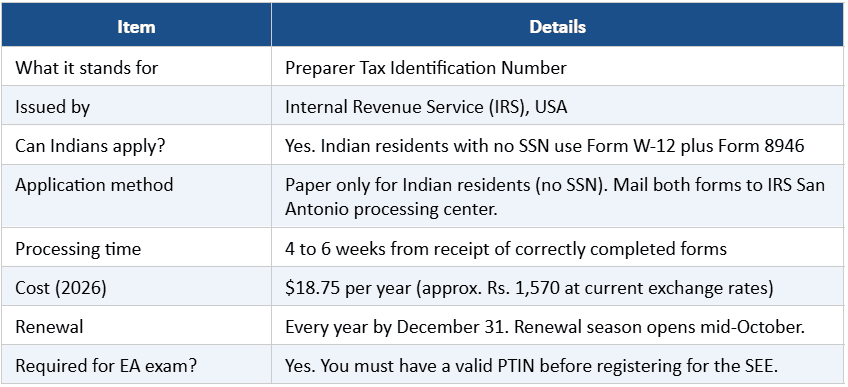
Not in the standard sense. The IRS PTIN online system requires a US Social Security Number (SSN) to create an account and complete the application in real time. Most Indian residents do not have a US SSN.
Indian applicants must use the paper application route. This involves completing Form W-12 and the supplementary Form 8946 together, attaching notarized copies of supporting documents, and mailing the package to the IRS processing center in San Antonio, Texas.
The paper route takes 4 to 6 weeks from the date the IRS receives your forms. Build this timeline into your EA preparation schedule. If you are planning to sit for the SEE in the July 2026 window with PSI Services, you should have your PTIN application submitted well in advance of May 1, 2026, when PSI registration opens.
Step 1: Download Form W-12
Form W-12, titled IRS Paid Preparer Tax Identification Number (PTIN) Application and Renewal, is the primary application form. Download the latest version directly from the IRS Form W-12 page. Always use the most current revision, which is updated periodically. As of 2026, the current version is revised October 2025.
Step 2: Download Form 8946
Because you do not have a US SSN, you must also complete Form 8946, titled PTIN Supplemental Application for Foreign Persons Without a Social Security Number. This form verifies your identity and confirms your status as a foreign person. It is submitted alongside Form W-12, not separately.
Step 3: Fill in Form W-12
Complete every section carefully. Key fields include:
Step 4: Fill in Form 8946
Form 8946 collects your identity and foreign status information. Complete the form with your legal name, date of birth, country of citizenship (India), and the details of your identity document. Sign and date the form. The signature must match the name on line 1.
Step 5: Prepare notarized copies of your documents
You need to submit notarized copies of two documents: one to confirm your identity and one to confirm your foreign status. Your Indian passport covers both requirements. A notarized copy of your passport, certified by a notary public legally authorized in your jurisdiction, is the most straightforward option.
The notarization must certify that the copy is a true and accurate reproduction of the original document. Indian notaries public are accepted by the IRS. Keep the originals. Only send notarized copies.
Step 6: Prepare the fee payment
The PTIN fee for 2026 is $18.75, which is approximately Rs. 1,570 at current exchange rates. The fee is non-refundable regardless of whether your application is approved.
For Indian residents paying in USD, the accepted methods are check or money order in US dollars made payable to IRS Tax Pro PTIN Fee. Most Indian applicants use an international demand draft or banker's cheque drawn on a US correspondent bank. Do not attach the payment to Form W-12. Keep it separate but include it in the same envelope.
Step 7: Mail the complete package
Place the following in a single envelope and mail to the IRS PTIN processing center:
Mail the package to: IRS Tax Professional PTIN Processing Center PO Box 380638 San Antonio, TX 78268 USA
Use a tracked international courier service. Keep your courier receipt and tracking number. The IRS does not acknowledge receipt, so tracking is your only confirmation that the package has arrived.
Step 8: Wait for processing and receive your PTIN
Processing takes 4 to 6 weeks from the date the IRS receives your forms. Once approved, you will receive your PTIN by email at the address you provided on Form W-12. Your PTIN begins with P followed by eight digits. Save this number securely. You will need it for exam registration, and it must appear on every US tax return you prepare for compensation.
PTIN Renewal: What Happens Every Year
All PTINs expire on December 31 of each year. A PTIN that was valid in 2026 becomes invalid on January 1, 2027 unless renewed.
Renewal season opens in mid-October each year. The IRS PTIN renewal page will show the renewal option once the window opens. The renewal fee is the same as the initial application fee, $18.75 for 2026, payable each year.
Once you have your PTIN established via the paper route and are assigned a PTIN number, the IRS sends an activation code each October that allows you to link your paper-registered PTIN to an online account. Using that account, future renewals can often be done online even without a US SSN. If you do not receive the activation code, contact the IRS PTIN Information Line at +1 319 464 3272 (international, not toll-free).
As a qualified EA, you must maintain a current and active PTIN throughout your enrollment. The IRS verifies PTIN status as part of the annual EA enrollment renewal process via Form 8554.
Many EA aspirants encounter both terms and confuse them. They serve different purposes and apply at different stages of your career.
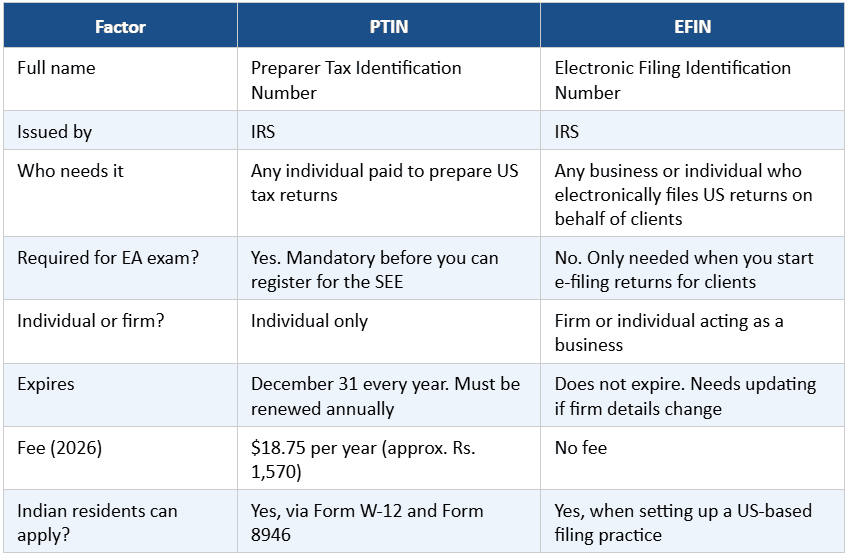
In simple terms: you need a PTIN before you can sit for the EA exam. You need an EFIN later, when you set up a practice and begin electronically filing US returns on behalf of clients. For most Indian candidates in the early stages of their EA journey, the PTIN is the only IRS number you need to obtain right now.
PTIN Cost in Indian Rupees 2026
The PTIN fee set by the IRS for 2026 is $18.75. At an approximate USD to INR exchange rate of Rs. 84, this translates to roughly Rs. 1,575.
There are additional practical costs to account for when applying from India:
Total estimated cost to obtain your PTIN from India in 2026: approximately Rs. 5,000 to Rs. 7,000, including all application, courier, and notarization costs. The PTIN fee itself is a small part of this. The courier and notarization are the larger practical expenses.
What is a PTIN and why do I need it for the EA exam?
A PTIN (Preparer Tax Identification Number) is a nine-digit number issued by the IRS to identify paid tax return preparers. It is a mandatory requirement for anyone who prepares US federal tax returns for compensation. For EA aspirants, the PTIN is also required before you can register for the Special Enrollment Examination. Without a valid PTIN, you cannot book an exam appointment through PSI Services.
Can Indian residents apply for a PTIN online?
Indian residents without a US Social Security Number cannot use the standard online PTIN system. You must apply using the paper route: complete Form W-12 and Form 8946, attach notarized copies of your passport, include the $18.75 fee in USD, and mail the package to the IRS processing center in San Antonio, Texas. Processing takes 4 to 6 weeks.
How long does a PTIN take to process in India?
The IRS takes 4 to 6 weeks to process paper PTIN applications from the date of receipt. International mail from India to the US typically takes 7 to 14 days each way. Budget a total of 7 to 9 weeks from the date you post your application to the date you receive your PTIN. Apply early so that the processing timeline does not delay your exam registration.
What is the difference between PTIN and EFIN in India?
A PTIN identifies you as an individual tax preparer and is required before sitting for the EA exam. An EFIN (Electronic Filing Identification Number) is required when you set up a business and begin electronically filing US tax returns for clients. They are separate IRS numbers for different purposes. As an EA aspirant, you only need a PTIN initially. An EFIN becomes relevant later when you start your practice.
Can I take the EA exam without a PTIN?
No. A valid PTIN is a mandatory requirement for EA exam registration. The IRS requires you to enter your PTIN when booking a seat for the SEE through PSI Services. You must obtain your PTIN before attempting to schedule your exam appointment. Since paper PTIN applications from India take 4 to 6 weeks to process, apply at least two months before you plan to book your exam.
What does a PTIN cost in Indian rupees in 2026?
The IRS fee for a PTIN in 2026 is $18.75, which is approximately Rs. 1,575 at current exchange rates. However, the total cost of obtaining a PTIN from India is higher when you include international courier charges (Rs. 2,500 to Rs. 4,500), notarization of your passport (Rs. 200 to Rs. 500), and bank charges for the USD demand draft (Rs. 200 to Rs. 500). Total cost from India is approximately Rs. 5,000 to Rs. 7,000.
Once you have your PTIN, the next step is structured exam preparation. Board360.ai's Enrolled Agent program is powered by HOCK International, with a 95% pass rate and full coverage of all three SEE parts. A free demo is available. Explore the EA program at Board360.ai and begin your preparation while your PTIN application is in transit.