

Menu
✕
April 13, 2026>Board360

Yes, B.Com graduates in India can pursue the US CPA. But a standard three-year B.Com alone is not enough. The US credit hour system evaluates your Indian degree differently. Most three-year B.Com programs convert to around 90 US credits. The CPA exam requires 120. The license requires 150.
The gap is real, but it is very bridgeable. This guide explains exactly how many credits your B.Com gives you, what options close the gap, which state boards work best for Indian candidates, and what steps to follow in 2026.
The US education system measures academic time in semester credit hours. One full year of undergraduate study earns 30 credits. A four-year US bachelor's degree therefore equals 120 credits.
Indian B.Com programs are typically three years. That puts most B.Com graduates at 90 US credit equivalents after credential evaluation. Some four-year B.Com (Hons) programs evaluate to 120 credits, but three-year programs consistently land at 90.
Two thresholds matter for the CPA:
Passing the exam without the 150-credit threshold means you hold exam passes but cannot use the CPA title professionally. You need the license for that. Most Indian candidates target 150 credits from the start to avoid re-qualification later.
A three-year B.Com from an Indian university typically evaluates to approximately 90 US semester credits. This is the baseline figure that credential evaluation agencies like NASBA International Evaluation Services (NIES) work with when assessing Indian degrees.
The exact number depends on your specific university, its NAAC accreditation grade, and the subjects covered. A NAAC A or A+ graded institution generally produces cleaner evaluations. Some evaluators have awarded up to 110 credits to strong B.Com programs, but 90 is the widely observed norm for three-year programs.
Here is how different qualification combinations typically map to US credits:
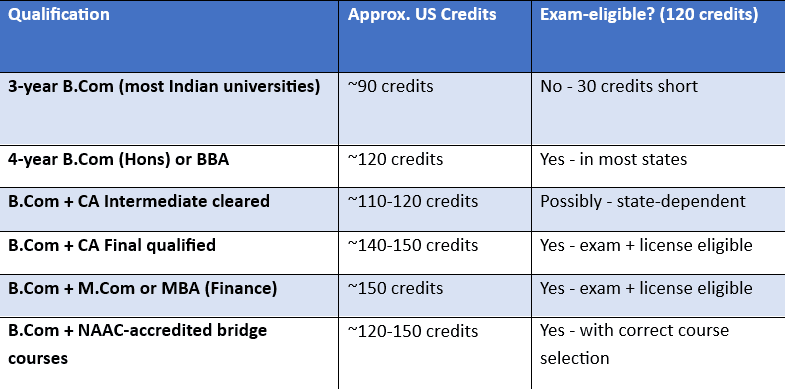
Note: these are estimates based on widely reported evaluation outcomes. Your actual credit count depends on NIES or WES assessment of your specific transcripts. Always get a credential evaluation before applying to a state board.
Path 1: B.Com + M.Com or MBA (Finance)
This is the most common and reliable route. An M.Com or MBA in Finance adds approximately 60 credits, pushing total credits to around 150. You meet both the exam and license thresholds cleanly. Most Indian universities offer M.Com programs in 2 years. You can pursue the CPA program alongside or immediately after your postgraduate degree.
Path 2: B.Com + CA Qualification
A B.Com combined with the CA qualification generally evaluates to 140-150 US credits. A B.Com + CA Final qualified candidate typically meets the 150-credit threshold for both exam and license in most US state boards. B.Com + CA Intermediate (cleared) may qualify for exam eligibility at 120 credits in some states, but falls short for the license. The full CA qualification is the stronger path.
Path 3: B.Com + NAAC-Accredited Bridge Courses
Bridge courses are short supplementary programs from NAAC-accredited Indian universities. They are specifically designed to help CPA candidates reach the 120 or 150 credit threshold without completing a full postgraduate degree. These courses typically cover accounting, business law, finance, and taxation subjects.
The key requirements for bridge courses to count toward your CPA credits:
Bridge courses are faster and less expensive than a full postgraduate degree. However, you must confirm your state board accepts them before enrolling. Most board-approved bridge course combinations take 6-12 months to complete. Your CPA coaching provider can guide you to the right program for your profile.
Path 4: 4-Year B.Com (Hons) or BBA
Candidates who completed a four-year undergraduate program, such as B.Com (Hons) from Delhi University or an equivalent BBA, often evaluate to 120 credits. This meets the exam eligibility threshold in most states. You will still need additional credits for the license, but you can sit for the exam while completing the remaining 30 credits through bridge courses or postgraduate study.
The CPA is governed by 55 US jurisdictions, each with its own rules. As an Indian candidate without a US Social Security Number (SSN) or US residency, your state board choice matters a great deal.
Three factors determine the best state for you:
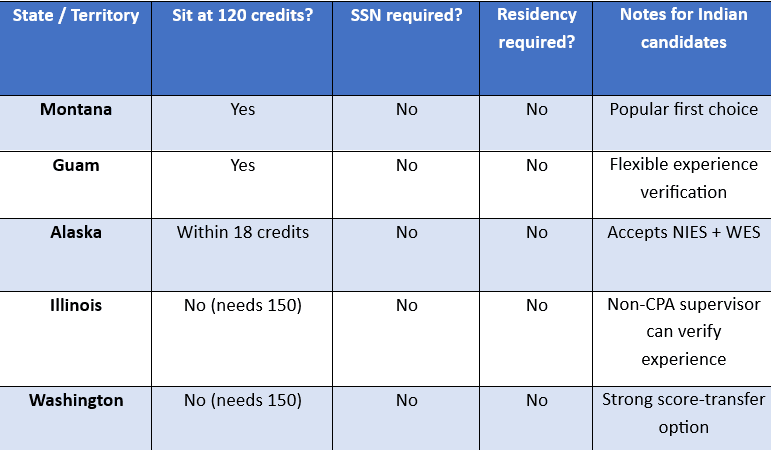
Montana and Guam are the most popular starting points for B.Com Indian candidates who have reached 120 credits through a bridge course or M.Com. They allow you to sit for the exam at 120 credits, require no SSN, and have no residency requirement. NASBA's state-by-state requirements page is the authoritative source to verify current rules before you apply, as requirements can change.
Before any state board can assess your eligibility, a NASBA-approved credential evaluation agency must translate your Indian transcripts into US credit equivalents. The two main agencies for Indian candidates are NASBA International Evaluation Services (NIES) and World Education Services (WES).
NIES is the preferred option for most Indian candidates. It is operated by NASBA itself, which gives it the best acceptance across state boards. Several states exclusively accept NIES and will not recognize a WES report. Submitting through NIES by default avoids this risk.
The evaluation process typically takes 8-12 weeks. Here is what you need to submit:
Start this process early. Indian universities can take 3-4 weeks just to process a transcript request. Add 8-10 weeks for the NIES evaluation itself. Build in at least 3-4 months before your planned state board application date.
If you are unsure which state to target, NIES offers an 'Undecided Jurisdiction Evaluation' at a small additional fee. They assess your credentials against multiple state boards and recommend the three best-fit jurisdictions for your profile. This is worth considering for B.Com candidates who are still choosing their path.
This distinction confuses a lot of candidates. Here is a clear breakdown.
120 credits is the threshold to sit for the CPA exam. Once you hit 120, you can apply to an eligible state board, get your Authorization to Test (ATT), and appear for the four exam sections. You are an 'exam passer' after clearing all four sections.
150 credits is the threshold to receive the CPA license. Only a licensed CPA can sign audit reports, use the CPA title, and practice in regulated roles. Almost every US jurisdiction requires 150 credits for the license, regardless of whether they allow exam-sitting at 120.
The practical implication: you can start the exam at 120 credits, but you should have a clear plan to reach 150 before you need the license. Many B.Com candidates begin exam preparation and bridge coursework simultaneously. By the time they pass all four sections, the 150-credit threshold is also met.
Board360.ai's CPA program is built around this reality. The curriculum prepares you for all four exam sections, and the team can guide you on credit planning based on your specific academic background. If you are still working out your eligibility, a free demo of the CPA program at Board360.ai is a good starting point.
Can a B.Com pass pursue the CPA in India?
Yes, but a standard three-year B.Com alone is not sufficient for CPA exam eligibility. Most three-year B.Com programs evaluate to approximately 90 US credits. Most state boards require 120 credits to sit for the exam. You need to bridge this gap through an M.Com, MBA, NAAC-accredited bridge courses, or the CA qualification before applying. A four-year B.Com (Hons) program may already meet the 120-credit threshold in some states.
How many credits does a B.Com give for the CPA in India?
A standard three-year B.Com from an Indian university is typically evaluated at approximately 90 US semester credit hours by NASBA International Evaluation Services (NIES). Some universities with strong NAAC accreditation or broader subject coverage may evaluate slightly higher, but 90 credits is the widely observed baseline. You need 120 for the exam and 150 for the license.
What is a CPA bridge course in India?
A CPA bridge course is a short supplementary academic program from a NAAC-accredited Indian university, specifically designed to help CPA candidates earn additional US-equivalent credits in accounting and business subjects. Bridge courses are shorter and less expensive than a full M.Com or MBA. They typically take 6-12 months and add 20-40 credits, depending on the program. Your CPA coaching provider can recommend approved options that evaluate cleanly through NIES.
Is there a list of NAAC A-accredited colleges for CPA bridge programs in India?
There is no single centralized list of colleges offering CPA-specific bridge programs. However, any NAAC A, A+, or A++ accredited institution offering accounting or business coursework can potentially qualify, subject to NIES evaluation. You can verify a college's current NAAC accreditation status directly on the NAAC official website. Your CPA coaching provider will typically have a curated list of evaluated bridge programs that have worked for previous candidates, which is the most practical starting point.
Can a B.Com graduate from Delhi University apply for the CPA?
Delhi University B.Com (Hons) is a three-year program. After credential evaluation, it typically converts to around 90 US credits, which falls short of the 120-credit exam eligibility threshold in most states. DU B.Com (Hons) candidates need to add credits through an M.Com, bridge courses, or CA qualification before applying. The good news is that DU's strong NAAC accreditation and standardized curriculum tend to evaluate cleanly through NIES, without documentation complications that can arise with less recognized institutions.
Do I need 150 credits for the CPA exam or just the license?
For the exam, you need 120 credits in most states (some states allow 120 with conditions; a few require 150 even to sit). For the CPA license, virtually all 55 US jurisdictions require 150 credits. This distinction is important for planning. You can begin your exam preparation and sit for the four sections with 120 credits, but you must complete the remaining 30 credits before you can claim the licensed CPA title. Most candidates resolve this by pursuing bridge courses or a postgraduate degree concurrently with their exam preparation.
Board360.ai's US CPA program is powered by UWorld's SmartPath technology, with a 94% first-attempt pass rate. The program covers all four CPA sections, and the team can help you map your B.Com credits to the right state board and bridge course plan. A free demo is available. Explore the CPA program at Board360.ai and start with a clear picture of your eligibility.